
Within the world of corporate digitalization and automation, an implicit, unspoken agreement often exists between the market and software providers: the client accepts that development will be a chaotic, opaque black box where deadlines are mere estimates, budgets stretch elastically, and half the operations collapse on deployment day. Many write this chaos off as the unavoidable price of modernization.
In reality, this is not a characteristic of technology—it is a failure of methodology.
No responsible business leader can afford to risk existing business continuity for the sake of growth. Technology must integrate into a company's daily operations invisibly, securely, and with a ruthless focus on profitability.
At Syntheticaire, we have completely broken away from the traditional software developer approach. We have established a transparent, precision-engineered customer journey that eliminates uncertainty from day one until final delivery. Here is how that comprehensive logic functions in practice, moving from ground zero to fully operational, autonomous processes.
Step One: The Ruthless Clean Data of Process Diagnostics
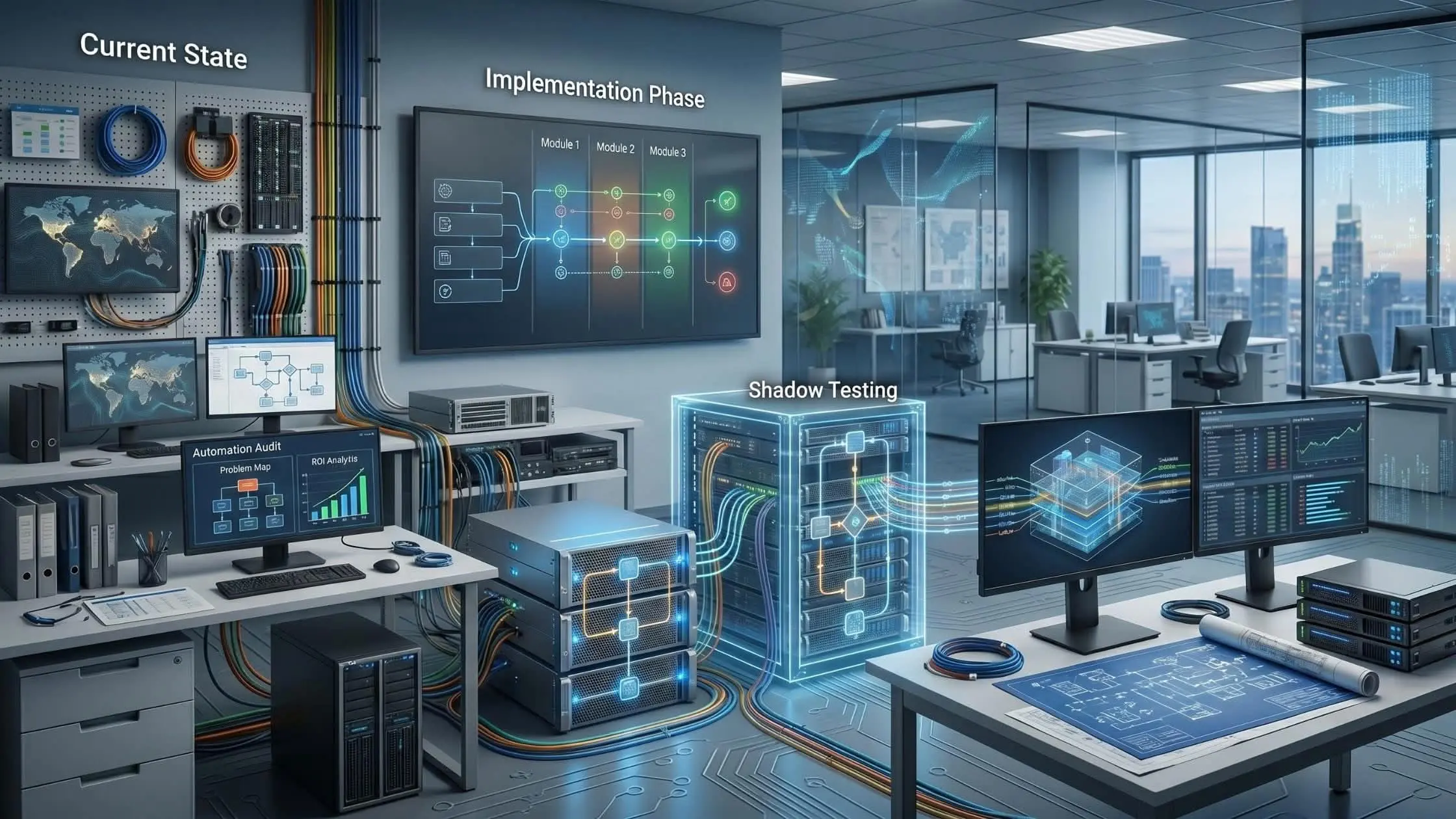
Every successful intervention is built upon a flawless understanding of the current state. We do not write code, suggest software, or make promises until we have evaluated the raw reality of the enterprise's operations. This is the Automation Audit phase.
During this stage, Syntheticaire’s experts do not ask management to fill out theoretical questionnaires. Instead, they sit down alongside frontline teams to directly trace the journey of data across systems.
The objective is to construct a precision-engineered problem map that exposes internal friction points, isolated software silos, and redundant manual decision-making nodes. At the conclusion of the audit, leadership does not receive an uninspired consulting presentation; they receive a rigorous decision-preparation document. This asset details exactly which processes drain time and capital, pinpoints the lowest-risk entry point, and outlines the projected return on investment (ROI) of the planned automation. This structured first step ensures that subsequent projects are built upon a validated, bulletproof foundation.
The Logic of Construction: Strictly Phased Implementation
Once the audit has established the correct trajectory and operational priorities, we firmly reject high-risk, all-at-once overhauls during execution. The project is systematically broken down into well-defined, independently functional phases, with a fixed scope and transparent goals assigned to each milestone.
If the assessment proves that incoming ticket and email management generates the heaviest administrative noise, we isolate and automate that single gateway during the initial thirty days.
This step-by-step construction guarantees the absolute security of ongoing operations. While the first module undergoes testing to reach one hundred percent precision in a live environment, subsequent phases remain entirely untouched. The internal core of the enterprise—billing, logistics, manufacturing—never grinds to a halt. There is no internal upheaval, and no stalled orders. Instead, the business experiences consecutive, rapid, and isolated victories that generate immediate profit and free up operational hours, allowing the project to become self-funding early in the cycle.
Shadow Testing and Risk-Free Live Deployment
The most critical juncture of our methodology occurs when the automated system is built but has not yet assumed control over daily operations. We refer to this as the "shadow testing" phase.
For several weeks, the background automation runs entirely in parallel with existing manual workflows. When a client request or data entry arrives, team members process it using legacy methods, while the automated system simultaneously executes its assigned logical operations in the background.
This approach allows us to measure the technological precision against live, real-world data without introducing operational exposure. Any necessary fine-tuning takes place here, behind the scenes. Once shadow testing proves that the system operates flawlessly and without human error, the transition is executed seamlessly at the press of a button.
The organization experiences no operational shock; on Monday morning, team members simply find that a portion of their manual workload has permanently vanished from their screens.
Long-Term Security: Strategic Partnership Over Rigid Software
Another major pitfall of traditional software development projects is abandonment. Many agencies consider their work complete the moment a system goes live, leaving the enterprise stranded with a rigid infrastructure.
What happens when a internal business rule changes next quarter, a new invoicing field becomes mandatory, or an entirely new category of client demand emerges in the market?
Companies often find themselves helpless because they lack the internal IT capacity to modify the technology, and they do not want their own specialists wasting valuable time on system administration tasks.
The Syntheticaire approach does not terminate at deployment; it enters a new phase. We do not sell boxed software; we provide a continuously functional, flexible infrastructure.
This means that following delivery, we remain positioned behind your processes as dedicated back-end support. If a client's business model evolves, or if new branches and modifications must be integrated into the system, there is no need to wait for weeks or maintain complex, internal development teams. Upon a single notification, we manage and implement the modifications as your external expert team, ensuring operations continue without a hitch.
This long-term strategic partnership guarantees that automation remains a dynamic framework that continuously adapts to the enterprise's growth rate, rather than a rigid digital shackle.
The hallmark of professional automation is not how complex the technology appears in the background, but how seamless, secure, and predictable the implementation process feels to the operation.
The question remains: will the internal chaos and risk of downtime associated with typical digitalization continue, or will the enterprise choose a transparent, precision-engineered upgrade?