
Last year, we embarked on an ambitious endeavor to make the entire AI development process more efficient without compromising the performance of the models. To achieve this, we formed teams of four and three members. The team of three worked based on a new “Synergy” methodology, while the team of four followed the traditional agile methodology (they were entirely unaware of the new methodology).
Why is this important?
- AI became the biggest buzzword in 2023-2024, making it imperative for companies to adopt these solutions.
- AI and ML models can provide a significant competitive advantage, especially in sectors where time is a critical factor.
- Saving money and time by efficiently moving models from the PoC phase to the production phase is essential.
- According to our survey, 76% of organizations fail with AI using Agile methodology.
How do we execute this?
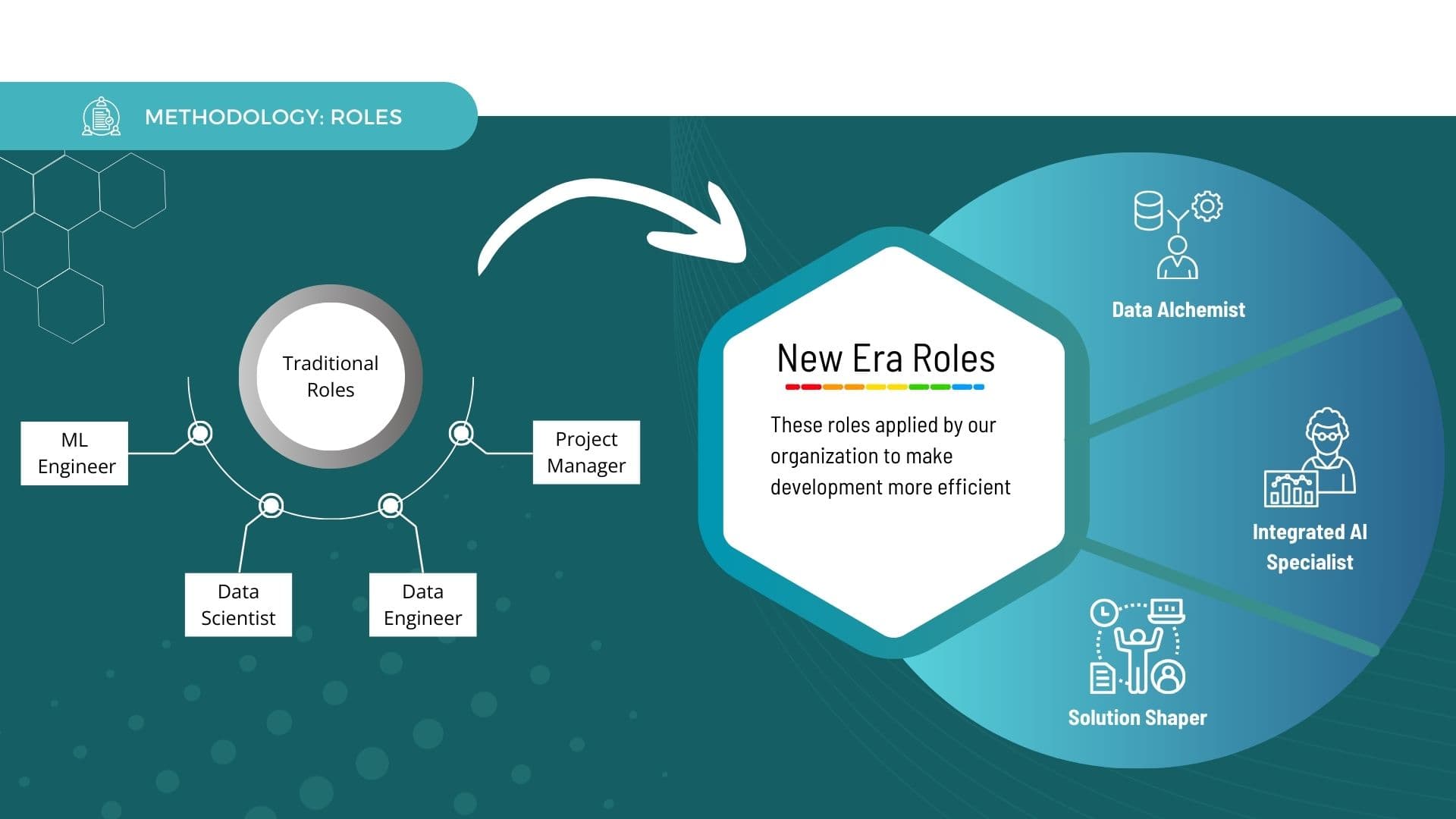
In conventional AI applications, roles are usually distinctly separated: Data Engineer, Data Scientist, ML Engineer, and Project Manager. These roles are costly, and full readiness is not always necessary. In our case, these roles were less divided, blending the Data Scientist and ML Engineer positions into an Integrated AI Specialist position. This ensures that PoC models can also be moved into production efficiently.
Efficient AI development strategy example
Another problem is the misinterpretation of agility. Agility is not about defining the final product and exact steps, but about setting a KPI-driven goal and iterating until the right solution emerges. Many projects fail due to poor iteration cycles and lack of AI-specific managerial knowledge.
Technological Methodology
AI projects often share similar components that can be standardized. During the evaluation period, we developed an AI architecture that:
- Integrates with existing systems
- Adapts to unique use cases
- Ensures code quality
Sectors where we tested the methodology
- Banking & Insurance: Customer segmentation to identify loan-receptive clients and craft personalized offers.
- Manufacturing: Predicting product defects, identifying responsible suppliers, and improving quality assurance.
- Agriculture: Measuring, predicting, and regulating growth factors like temperature, humidity, and soil quality.
- Telecommunications: Personalized offers based on user habits, improving customer loyalty (retaining is 4x cheaper than acquiring).
Lessons Learned – Results Compared to the Control Group
Team Dynamics & Task Distribution
| Aspect | Old Methodology | New “Synergy” Methodology |
|---|---|---|
| Meeting time | 52% more | Streamlined (Impact Report, Review Rally) |
| Coding style | More independent, misaligned | More pair coding (7% of time), better delegation |
| Meeting types | Standup, Planning, Demo, Retro (caused friction) | Only Impact Report & Review Rally (no negative feedback) |
Development Process
| Phase | Old Methodology | New “Synergy” Methodology |
|---|---|---|
| Task allocation | Focused on bug fixing | Focused on standardization |
| Initial start | Results after week 1 | Testable results after week 2 |
| Endgame | Hard to adapt changes | Easily integrated changes |
Results
| Metric | Old Methodology | New “Synergy” Methodology |
|---|---|---|
| Time spent (first project) | 66 days | 57 days |
| Time spent (all projects) | 391 days | 192 days |
| Time in meetings | 37 days | 17 days |
| Features developed | 214 | 568 |
| Stakeholder satisfaction | 7.3 | 9.2 |
| Team comfort | 8.3 | 8.9 |
Final Results
- Efficiency: Synergy methodology is 5.4x more efficient based on features delivered vs. time spent.
- Stakeholder satisfaction: +26% improvement.
- Team comfort: No significant difference (both positive).
Conclusion
It is evident that, regardless of the industry, we can organize human teamwork in IT to gain a significant advantage. A team of the same size working 5x more efficiently without new tools proves that what we need is a shift in perspective, not just technology.
At Syntheticaire, we can assist with this transformation through education, workshops, process optimization, or tailored development (UI/UX, backend, frontend, AI development).
📩 Contact us via form or email at info@syntheticaire.com.
Because unique solutions and proven results are what your organization deserves.